

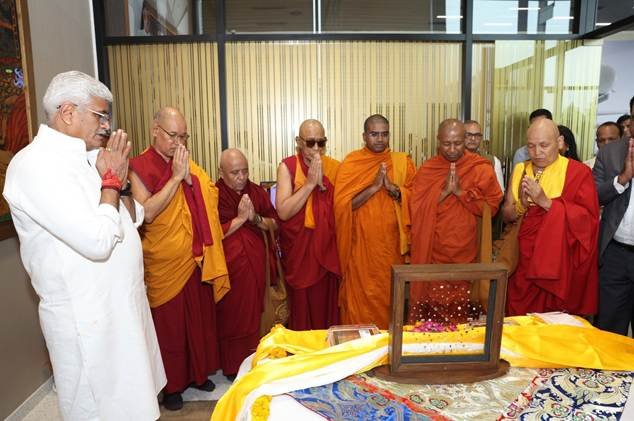
The Piprahwa Gems Repatriation India marks the return of over 300 ancient jewels linked to the relics of the Buddha. After 127 years abroad, the collection came home through decisive government action that stopped a Sotheby’s auction in Hong Kong. Discovered in 1898 by British engineer William Claxton Peppe in Piprahwa, Uttar Pradesh, near Nepal’s border, the gems are believed to be over 2,000 years old and buried alongside the Buddha’s remains. In May, the Culture Ministry issued a legal notice to Sotheby’s, calling the relics “inalienable religious and cultural heritage” and citing both Indian laws and UN conventions. This move, combined with diplomatic outreach, halted the auction and opened the door for an innovative public-private partnership (PPP) to secure the artifacts’ return.
The repatriation was possible through collaboration between the Indian government and Mumbai-based Godrej Industries Group. The government managed legal negotiations and diplomacy, while Godrej funded the acquisition. This partnership resembled infrastructure PPPs, where the public sector provides authority and oversight and the private sector offers resources and agility. Culture and Tourism Minister Gajendra Singh described the recovery as “one of the most significant instances of heritage repatriation.” Pirojsha Godrej, Executive Vice Chairperson of Godrej Industries Group, said the gems are “timeless symbols of peace, compassion, and the shared heritage of humanity.” The Piprahwa Gems Repatriation India shows that PPPs can safeguard not just roads and bridges but also invaluable cultural treasures.
Dr. Pranshu Samdarshi of Nalanda University said the gems’ return “reaffirms India’s central place in the Buddhist world.” Their formal unveiling will also strengthen cultural ties with countries like Thailand, Sri Lanka, and Myanmar. Over the past decade, India has recovered more than 600 artifacts from nations including the US, France, and Australia. The Piprahwa Gems Repatriation India stands out as a prime example of how legal action, diplomacy, and PPP financing can combine to reclaim heritage. Other nations are now studying this approach for similar cases. By applying PPP structures to cultural diplomacy, India has widened the scope of public-private cooperation.
Traditionally, PPPs have focused on transport, energy, and urban projects. This case proves they can also protect cultural heritage. Governments can contribute legal authority and heritage expertise, while private partners handle acquisition costs, logistics, and preservation. This role-sharing reduces financial risk, accelerates negotiations, and builds shared accountability. In heritage cases, quick action is vital, auctions move fast, and artifacts in private collections may be lost for generations. Using PPPs, governments can act decisively, aligning cultural goals with corporate social responsibility commitments. India’s model for the Piprahwa Gems could inspire global efforts to safeguard identity, history, and diplomacy.
Source:
