

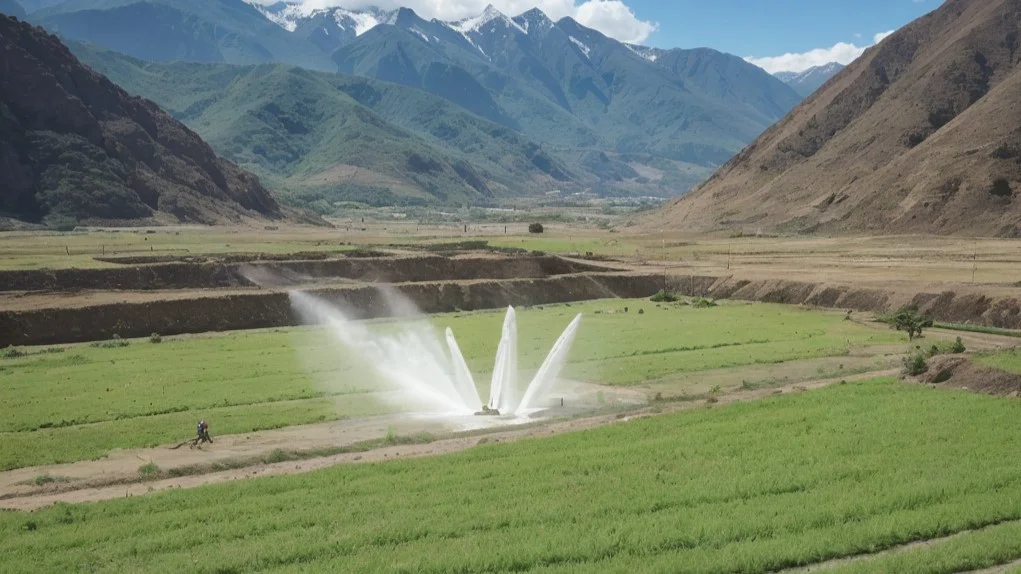
Peru- The private investment agency of Peru, ProInversion, is advancing two significant irrigation projects through Public-Private Partnerships (P3s) with a combined estimated value surpassing $1 billion. This strategic initiative underscores Peru’s commitment to leveraging private sector efficiency and resources to drive public sector goals, particularly in the realm of agricultural development and food security.
ProInversion has kickstarted feasibility studies for the Santa River Diversion Project and the Chancay-Lambayeque Valley Water Projects, earmarked at approximately $420 million and $580 million respectively. These projects represent a cornerstone in the country’s efforts to expand arable lands, aiming to add around 46,000 hectares of agricultural land across the Chinecas and Chancay Lambayeque valleys. This expansion is a testament to Peru’s vision of transforming its agriculture sector into a powerhouse for agro-exports, capitalizing on the global demand for high-value agricultural products.
The Santa River Diversion Project, alongside the Chancay-Lambayeque Valley Water Projects, is not just an irrigation venture but a multi-faceted development strategy designed to increase farmland productivity. By doing so, these projects are poised to contribute significantly to Peru’s food security, ensuring a steady supply of agricultural produce both for domestic consumption and international markets. This initiative aligns with global sustainable development goals, highlighting the pivotal role of innovative agricultural practices in achieving food security and economic resilience.
José Salardi, the executive director of ProInversion, emphasized the transformative potential of these megaprojects for the nation’s agro-export sector. According to Salardi, an estimated investment of $1 billion is required for the execution of these projects, a move expected to strengthen the supply of high-value agricultural products significantly. Beyond the direct benefits to the agriculture sector, these projects are anticipated to catalyze economic growth and generate substantial employment opportunities across the country, showcasing the multifaceted impacts of well-executed P3s in infrastructure development.
The undertaking of these feasibility studies marks the beginning of a journey towards realizing these ambitious projects. Once completed, the Santa River Diversion and Chancay-Lambayeque Valley Water Projects will be developed as P3s, a model that has increasingly become a linchpin in executing large-scale infrastructure projects globally. This approach leverages the strengths of both the public and private sectors, marrying public sector oversight with the efficiency, innovation, and capital of the private sector.
Peru’s initiative exemplifies the growing trend of utilizing P3 models to address critical infrastructure needs, especially in sectors crucial for economic and social development. As these projects progress, they are set to become benchmarks in the application of P3 frameworks in the agricultural sector, offering valuable lessons and insights for similar initiatives worldwide.
Soruce:
